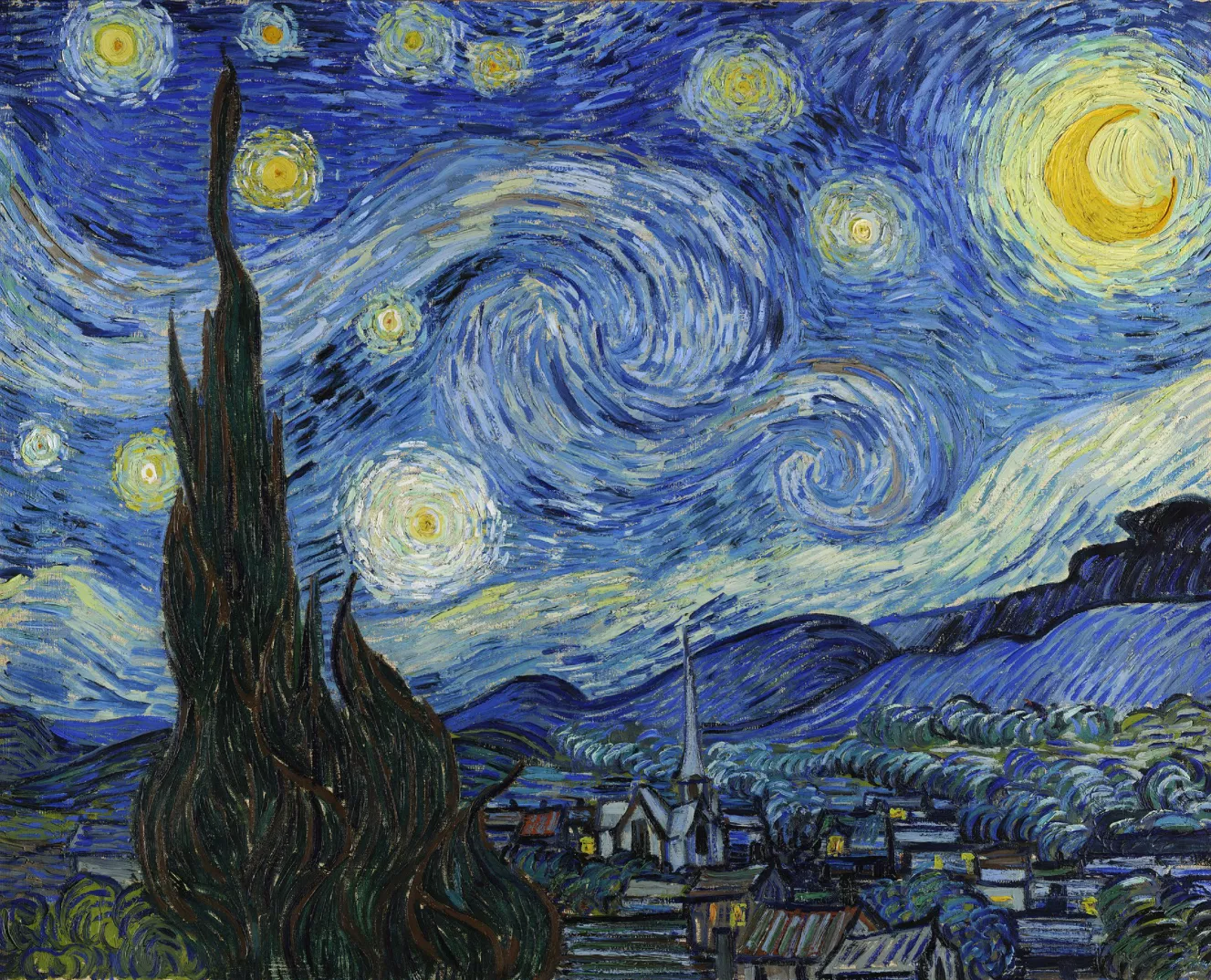
The Starry Night
Night landscape
A swirling night sky rises above a quiet village in one of van Gogh's most recognizable images, where movement, light and imagination combine into a deeply expressive vision.
Vincent van Gogh was a Dutch painter and one of the defining figures of Post-Impressionism, known for vivid color, energetic brushwork and paintings that gave ordinary subjects unusual emotional force.
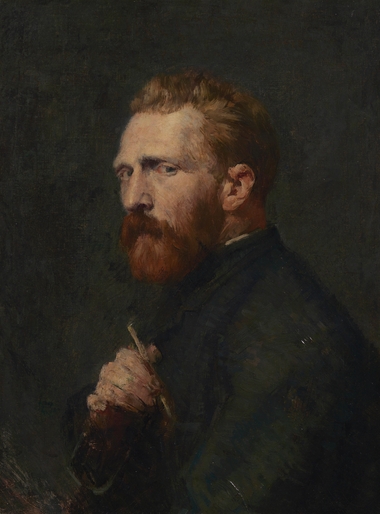
Van Gogh developed a highly personal visual language built on strong color contrasts, directional brushstrokes and simplified but expressive forms. His paintings often transform fields, flowers, bedrooms, cypress trees, cafes and self-portraits into images charged with movement, structure and feeling.
Born in the Netherlands, Vincent van Gogh worked in several occupations before committing fully to art. His artistic career lasted only about a decade, yet in that short time he produced an extraordinary body of paintings and drawings.
Exposure to modern painting in Paris broadened his palette and changed the direction of his work. The years in Arles, Saint-Remy and Auvers-sur-Oise brought the bold color, emphatic brushwork and psychological intensity most closely associated with his mature style.
What makes van Gogh especially important is the speed and clarity of his development. Within a relatively short period, he transformed everyday subjects into images of unusual emotional force and formal energy.
Vincent van Gogh paintings bring intensity, rhythm and visual character into interior spaces. Some works feel bright and uplifting, while others create a more reflective atmosphere, making his art especially effective in rooms that benefit from color, movement and emotional presence.
Works with strong yellows and blues can energize a room, while quieter landscapes and floral studies often create a more contemplative mood. That range is part of what makes van Gogh unusually flexible in interiors despite the strength of his style.
Even when the subject is simple, the surface energy of the painting gives the room a sense of movement. For a broader selection, see more Vincent van Gogh paintings.
Van Gogh's art is built on vivid color, active brushwork and a strong sense of directional movement across the painted surface. His pictures often feel immediate because the paint itself seems to record energy, pressure and attention in real time.
He returned again and again to subjects such as fields, flowers, cafes, orchards, trees, bedrooms, portraits and night skies. These are familiar motifs, but in his hands they rarely remain ordinary; they become charged through contrast, contour, rhythm and emotional compression.
In works from Arles and Saint-Remy especially, color becomes structural rather than merely descriptive. It does not simply describe what something looks like, but helps determine the mood, tension and internal architecture of the image.
Van Gogh's influence expanded dramatically after his death and his work became central to the story of modern art. Later artists responded to the freedom of his brushwork, the force of his contours and his willingness to let color carry emotional meaning.
His paintings were especially important for artists associated with Fauvism and Expressionism, who recognized in his work a new way of using paint not only to describe the visible world, but to intensify and reinterpret it.
That influence persists because van Gogh showed that personal vision could shape form itself. His art helped open the way for later painters who treated color, surface and distortion as expressive tools rather than secondary effects.
Selected works that help introduce the visual language, themes, and atmosphere associated with this subject.
Night landscape
A swirling night sky rises above a quiet village in one of van Gogh's most recognizable images, where movement, light and imagination combine into a deeply expressive vision.

Still life
This celebrated series turns a vase of flowers into a study of color intensity, texture and painterly rhythm, making an ordinary subject feel radiant and monumental.

Floral study
Irises balances decorative beauty with directional energy, using strong contrasts and flowing contours to create a surface that feels both controlled and alive.

Landscape
A wide field animated by bright red poppies becomes a vivid study in color contrast, open space and directional brushwork, turning a simple rural view into something energetic and intensely alive.

Landscape
Dark birds, an open path and a charged sky create a landscape that feels restless and dramatic, compressing tension into a powerful rural scene.
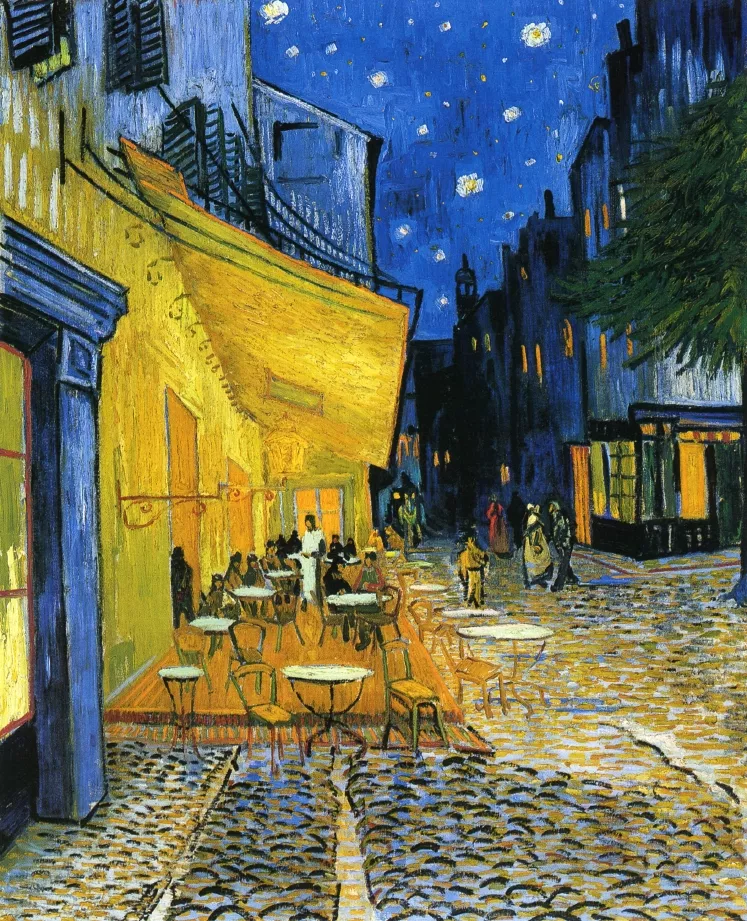
City scene at night
Warm yellow cafe light spills into a deep blue evening sky, creating one of van Gogh's most memorable nocturnal scenes and a striking contrast between intimacy, color and urban atmosphere.
Van Gogh remains compelling because his paintings combine immediacy with formal control. Even when the brushwork appears spontaneous, the structure underneath is deliberate and strong.
His images also resist becoming merely iconic. They are famous, but they still reward close looking: the relationships between color, line and surface continue to generate tension, rhythm and feeling.
That is one reason his work still resonates so widely today. It feels deeply personal, yet it also speaks to broader questions about perception, emotion, solitude, beauty and the expressive possibilities of painting itself.
He is best known for emotionally intense Post-Impressionist paintings with vivid color, energetic brushwork and iconic works such as The Starry Night, Sunflowers and Irises.
He received limited recognition while he was alive and his full influence became much more visible after his death as later artists responded to his style and use of color.
He is most closely associated with Post-Impressionism, though his emotional directness and painterly energy had a strong impact on later Expressionist artists.
His paintings are recognizable because of their vivid color, animated brushwork, simplified forms and the way ordinary subjects become emotionally charged and visually memorable.
Paris, Arles, Saint-Remy and Auvers-sur-Oise were especially important in shaping the mature style and major works for which he is now famous.
Browse more pages, paintings, and subject-focused content on this minisite.